Easy Math Dice Games
Math Games That Make Numbers Fun
Let’s talk about the secret weapon every parent needs in their back pocket. Math dice games turn those dreaded homework battles into genuine fun, and trust me, your kids won’t even realize they’re learning.
These games work because they sneak education into play time. No worksheets, no complaints, just rolling dice and having a blast while building essential math skills. Whether you’ve got a kindergartener just learning to count or a fourth grader tackling multiplication, there’s a perfect dice game waiting.
Ready to transform math from chore to choice?
Why Math Dice Games Work So Well
- Kids love the element of chance and surprise that dice bring to learning
- They practice math facts without the pressure of timed tests or worksheets
- Simple materials mean you can play anywhere, anytime
- Games naturally encourage repetition, which builds fluency
- Success feels earned rather than assigned, boosting confidence
- Multiple players mean built-in motivation and friendly competition
Simple Addition and Subtraction Games
Roll and Add
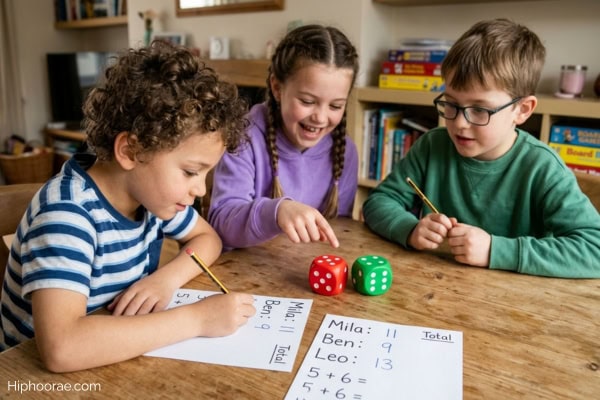
The gateway game that gets everyone started. Players roll two dice, add the numbers together, and write down their sum. After ten rounds, whoever has the highest total wins. This game builds basic addition skills while introducing the concept of keeping score and comparing numbers.
Difference War
Each player rolls two dice and finds the difference between the numbers. The player with the largest difference wins that round and collects all the dice rolled. It’s like the classic card game War, but with subtraction practice built right in. Kids love the competitive element while mastering the concept of finding differences.
Race to 50
Players take turns rolling one die and adding that number to their running total. First person to reach exactly 50 wins, but here’s the catch: if you go over, you have to subtract your roll instead. This game teaches both addition and subtraction while introducing strategic thinking about when to take risks.
Target Number
Choose a target number between 10 and 20. Players roll three dice and use addition or subtraction to get as close to the target as possible. They can add all three, subtract one from the sum of the other two, or use any combination. This flexibility helps kids see numbers in different ways while practicing both operations.
Multiplication and Division Adventures
Multiplication War
Perfect for kids learning their times tables. Each player rolls two dice and multiplies the numbers together. Highest product wins the round. Start with smaller dice for beginners, then graduate to larger numbers as confidence grows. The repetition happens naturally through play rather than drilling.
Factor Frenzy
Roll two dice and multiply them together to get your target number. Then see how many different factor pairs you can find for that number using additional dice rolls. This game deepens understanding of multiplication relationships and introduces the concept of factors in a hands-on way.
Division Derby
Players roll two dice, with the larger number as the dividend and smaller as the divisor. Calculate the quotient and remainder. Points are awarded for both the quotient and any remainder. This makes division practice engaging while teaching kids that remainders are perfectly normal and useful.
Array Builder
Roll two dice to determine the dimensions of your array, then use small objects like coins or blocks to build it. Count up the total to practice multiplication facts. This visual approach helps kids understand that multiplication is really about making groups, not just memorizing facts.
Place Value and Number Sense Games
Build the Biggest
Each player rolls three dice and arranges the numbers to create the largest possible three-digit number. Then compare to see who built the biggest. This game reinforces place value concepts while teaching strategic thinking about digit placement.
Round It Up
Roll three dice to create a three-digit number, then practice rounding to the nearest ten and hundred. Players earn points based on how close their rounded estimates are to specific targets. This makes abstract rounding concepts concrete and purposeful.
Place Value Showdown
Players roll four dice and arrange them to make two two-digit numbers. Then they add, subtract, multiply, or divide their numbers depending on the round. This game combines place value practice with all four operations, showing how digit placement affects calculations.
Problem-Solving and Strategy Games
Equation Builder
Roll five dice and use all the numbers to create a true mathematical equation. You can use any operations and parentheses, but every die must be used exactly once. This open-ended challenge encourages creative thinking and shows kids that math can be like solving puzzles.

Beat the Calculator
One player uses a calculator while others use mental math and dice games to solve the same problems. Often the dice players win because they’re not fumbling with buttons. This builds confidence in mental math abilities while making calculation speed feel like a superpower.
Pattern Detective
Create sequences using dice rolls, then challenge other players to figure out the pattern and predict the next numbers. This game develops algebraic thinking and pattern recognition skills that form the foundation for advanced math concepts.
Fraction and Decimal Fun
Fraction Action
Roll two dice to create fractions, with the first roll as the numerator and second as denominator. Practice comparing fractions, adding simple fractions, or converting to decimals. Use multiple dice to create more complex fractions as skills develop.
Decimal Derby
Roll dice to create decimal numbers, then practice ordering them from smallest to largest or adding them together. Start with tenths and work up to hundredths as kids get comfortable with decimal placement.
How to Make Math Dice Games a Success
- Start with games that match your child’s current skill level, then gradually increase difficulty
- Keep sessions short and sweet – 15 to 20 minutes prevents mental fatigue
- Celebrate effort and improvement rather than just correct answers
- Have kids explain their thinking out loud to reinforce learning
- Create a special dice game kit with different colored dice and a score pad
- Let kids modify rules or create their own variations once they understand the basics
- Play alongside your kids rather than just supervising – your enthusiasm is contagious
- Use these games as warm-ups before homework or as brain breaks between subjects
The magic of math dice games isn’t just in the learning that happens. It’s in watching your child’s face light up when they realize they can actually enjoy working with numbers. These games prove that math doesn’t have to be intimidating or boring.
Remember, you don’t need fancy materials or complex rules to create meaningful learning experiences. A handful of dice and a willing spirit are all it takes to turn your kitchen table into a math adventure zone. Your kids will develop number sense, build confidence, and maybe even start asking for extra math practice. Now grab those dice and let the mathematical fun begin!